

ADA Website Accessibility & Compliance Guide

Why Web Accessibility Is Critical for Modern Businesses
The Americans with Disabilities Act (ADA) of 1990 protects individuals with disabilities from discrimination in employment, transportation, education, public services, communication, and digital access.
Today, websites and web applications are considered public-facing services, which means accessibility is no longer optional—it is a legal, ethical, and business requirement.
At TechIndia, we help organizations build ADA-compliant, accessible, and SEO-optimized websites that improve user experience, reduce legal risk, and expand audience reach.
What Is Web Accessibility?
Web accessibility ensures that people with disabilities can perceive, understand, navigate, and interact with websites and digital applications.
This includes users with:
- Visual impairments
- Hearing impairments
- Physical or motor disabilities
- Cognitive and neurological conditions
An accessible website benefits everyone, not just users with disabilities:
- Better SEO rankings
- Higher engagement and conversion rates
- Improved usability across devices
- Stronger brand trust and inclusivity
Why ADA & Web Accessibility Matter for SEO and Revenue
Accessible websites:
- Rank higher in search engines
- Reduce bounce rates
- Increase conversion rates
- Reach a wider audience
- Protect businesses from ADA-related lawsuits
📌 69% of users leave a website immediately if it’s not accessible
Accessibility is not a cost — it’s a growth strategy.
What Is Section 508 of the Rehabilitation Act?
Section 508 of the Rehabilitation Act of 1973 requires that all electronic and information technology (EIT) used by US federal agencies be accessible to people with disabilities.
While ADA applies broadly to public and private organizations, Section 508 specifically applies to federal systems and organizations working with government entities.
Most Section 508 requirements align closely with WCAG standards.
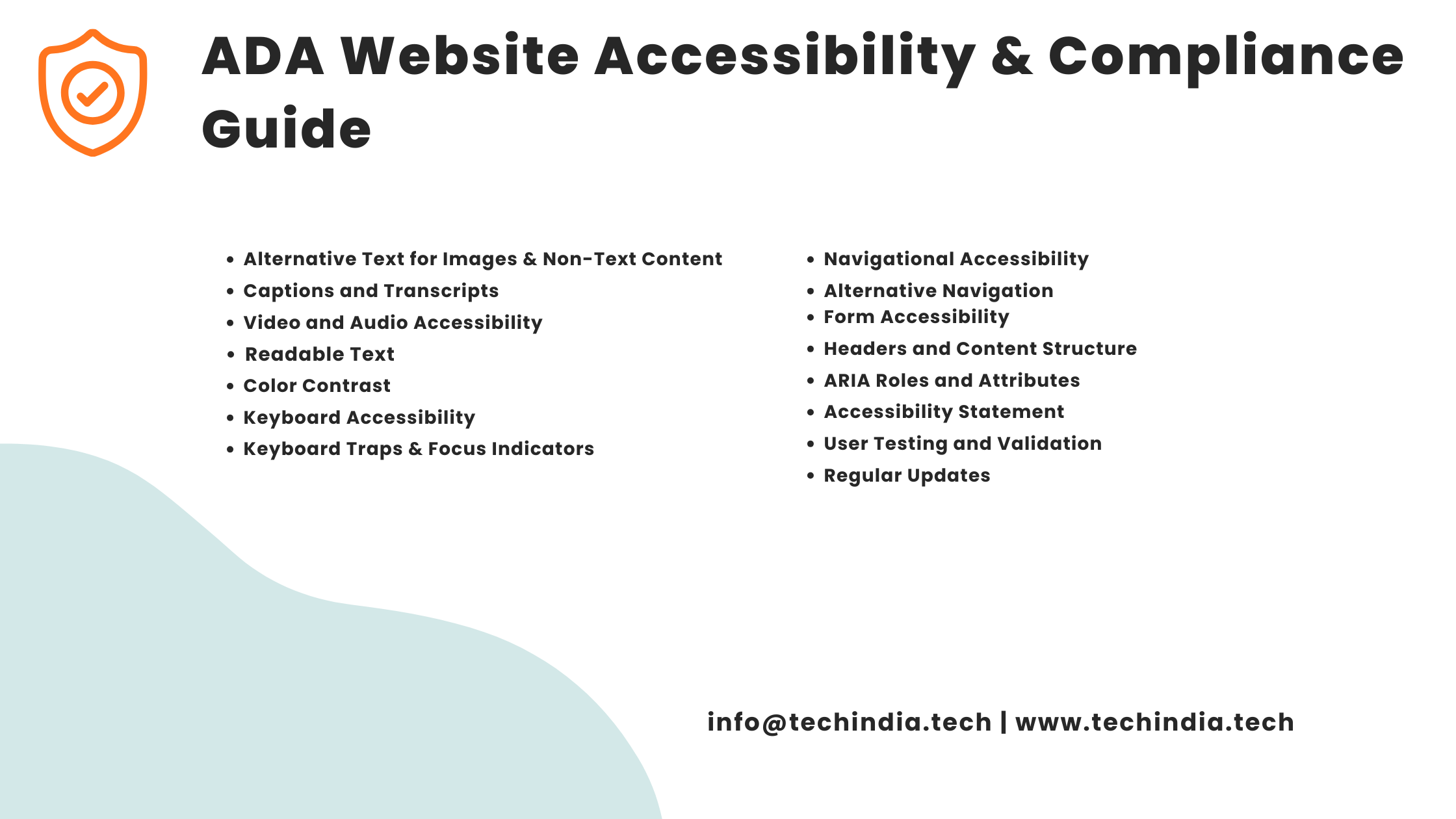
ADA & Section 508 Compliance Checklist (15 Key Areas)
1. Alternative Text (Alt Text)
All images, icons, and non-text content must include meaningful alt text.
– Improves accessibility
– Boosts SEO and image search rankings
2. Captions & Transcripts
Videos and audio must include captions or transcripts for users with hearing impairments and search engines.
3. Video & Audio Accessibility
- Accessible controls
- Captions or transcripts
- Avoid flashing or distracting animations
- Audio descriptions where required
4. Readable Text
- Clear, legible fonts
- Scalable text without breaking layout
- Avoid very small font sizes
5. Color Contrast
Ensure strong contrast between text and background to meet WCAG standards.
6. Keyboard Accessibility
All features must work using keyboard-only navigation—including forms, menus, and buttons.
7. Focus Indicators & No Keyboard Traps
Users must clearly see where they are on the page and never get “stuck” in elements.
8. Navigation Accessibility
- Consistent navigation
- Logical menu structure
- “Skip to content” links for screen readers
9. Alternative Navigation
Sitemaps, breadcrumbs, and alternative paths help users find content easily.
10. Accessible Forms
- Clear labels
- Helpful error messages
- Easy submission flow for assistive technologies
11. Proper Headings & Content Structure
Use semantic HTML (H1 → H2 → H3) to improve:
- Accessibility
- SEO
- Content clarity
12. ARIA Roles & Attributes
ARIA helps screen readers understand dynamic components like modals, tabs, and live content.
13. Accessibility Statement
A public accessibility statement shows compliance commitment and provides contact details for reporting issues.
14. User Testing & Validation
- Automated accessibility testing tools
- Manual testing with assistive technologies
- Feedback from users with disabilities
15. Regular Updates
Accessibility standards evolve. Regular reviews ensure long-term compliance.
Accessibility Standards We Follow at TechIndia
- WCAG 2.1 / 2.2
- ADA Title II & III
- Section 508 (US)
- AODA (Canada)
- EN 301 549 (Europe)
Why Choose TechIndia for ADA Compliance?
At TechIndia, accessibility is built into our development process—not added later.
Our ADA Accessibility Services Include:
- Accessibility consultation & planning
- ADA & WCAG audit reports
- Section 508 compliance checks
- Accessibility remediation & fixes
- Ongoing monitoring & support
We work extensively with:
- Healthcare clinics & hospitals
- Dental & medical practices
- E-commerce platforms
- SaaS & enterprise systems
- Government & public services
Why Businesses Are Moving to SLM-Based AI
- Lower cost
- Faster automation
- Better customer experience
- Secure data handling
- Easy scaling
- Real ROI
SLMs are not experimental AI—they are production-ready business tools.
Final Thoughts
SLM (Small Language Models) are transforming how small and medium businesses adopt AI.
Instead of spending heavily on large, complex AI systems, business owners can now:
- Automate operations
- Improve customer support
- Reduce manual work
- Make smarter decisions
- Build trust through accuracy
If you want AI that actually helps your business, SLM is the right starting point.
Tech India helps businesses design, deploy, and scale secure, SLM-powered AI systems tailored to real business needs.
